Video Management Systems (VMS) sit at the heart of modern security operations. They are used everywhere: airports, traffic, data centres, factories, hospitals, campuses, and public spaces.
Cameras capture what is happening, analytics flag unusual behaviour, and operators get a live view of the environment.
However, visibility alone does not guarantee an effective response. In many organisations, VMS incidents are still confined to control-room screens or dashboards. When an alert appears, but the right responder is not immediately notified, the incident can escalate before action is taken. In security and safety operations, delays of even a few minutes can lead to operational disruption, safety risks, or compliance issues. That is why real-time VMS alerting matters.
The overlooked risk in VMS operations
While video analytics and security events often receive the most attention, some of the most disruptive VMS failures occur quietly during day-to-day operations. These issues may not present as obvious alarms and frequently remain unnoticed until video is required for review or investigation.
Every day, a VMS generates operational signals. Storage capacity increases gradually, reducing effective retention periods. Recording performance degrades as system load rises. Frames are dropped without immediate visibility, and servers operate under sustained CPU, memory, or I/O pressure.
In many cases, cameras continue to appear online and dashboards show normal status, yet recorded video may be incomplete, degraded, or missing altogether.
When these conditions are only discovered after an incident has occurred, critical video evidence may already be unavailable, impacting investigations, compliance, and operational response.
What a Comprehensive VMS Alerting Strategy Must Cover
An effective VMS alerting strategy goes beyond camera analytics and intrusion events. It must also cover the operational conditions that determine whether video is reliably recorded, retained, and usable.
Key alert categories include:
Storage and retention alerts
Alerts should be triggered when storage utilisation reaches defined thresholds or when retention periods fall below policy requirements. This allows teams to act before recordings stop or evidence is overwritten.
Recording continuity and video loss alerts
Recording interruptions, dropped streams, excessive frame loss, or recording service failures must be detected immediately. Cameras may appear online while recordings silently fail, making continuity alerts essential.
Network and connectivity alerts
Bandwidth congestion, packet loss, PoE instability, switch port issues, or WAN connectivity problems directly impact video quality and availability. Network-related alerts help isolate the root cause before video degrades further.
Server, recorder, and VMS service health alerts
High CPU, memory, GPU, or disk utilisation, recorder service failures, database issues, or system instability can degrade or stop recording. Health alerts ensure platform issues are addressed before they affect operations.
Cybersecurity and compliance alerts
Often overlooked, these include unauthorised login attempts, privilege changes, firmware modifications, audit log failures, or abnormal video export activity. These alerts support governance, compliance, and insider threat detection.
From VMS Events to Actionable Alerts
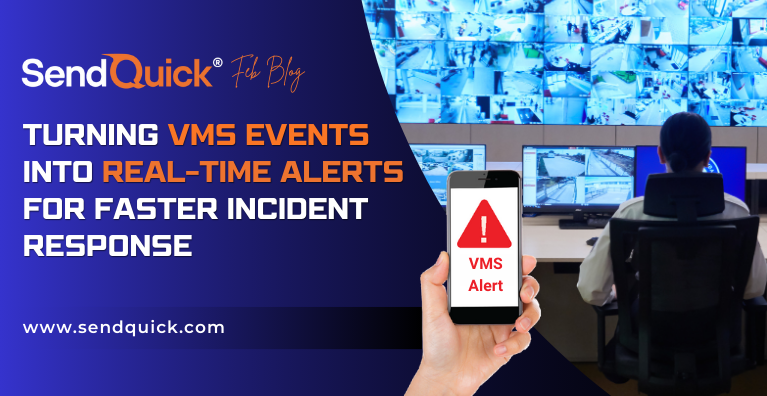
An effective VMS alerting approach extends beyond the camera system itself. When a VMS event is triggered, it should automatically initiate an alerting workflow that notifies responders in real time.
By integrating VMS platforms with a centralised alerting solution such as SendQuick, organisations can bridge the gap between detection and response. Instead of remaining within the VMS console, alerts are pushed directly to security, facilities, and operations teams through predefined communication channels.
This ensures that incidents are communicated immediately, regardless of where responders are located, and without relying on continuous screen monitoring.
Managing VMS Alerts with SendQuick.
SendQuick turns VMS events into actionable, omnichannel notifications so the right teams can respond immediately, on-site or remotely.
- Teams are alerted when storage capacity threatens retention targets
- Recording failures and video loss are surfaced immediately
- Server, recorder, and network issues are escalated before video availability is impacted
- Alerts are routed to the right responders and escalated automatically if no action is taken
- Security and system events, such as unauthorised logins, privilege changes, and abnormal video exports, are flagged to support threat detection.
To learn more about integrating your Video Management System with SendQuick for real-time, centralised alerting, contact us to discuss your operational requirements or request a technical briefing.