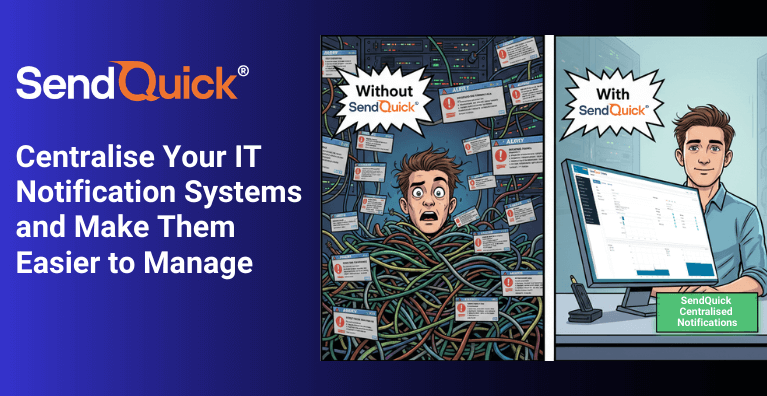
IT alerts are meant to protect your infrastructure, not overwhelm your teams. Yet in many organisations, notifications are scattered across monitoring dashboards, email inboxes, messaging platforms, and standalone security systems. When incidents occur, teams waste valuable minutes switching between tools, manually escalating issues, and determining ownership.
The result is slower response time, higher operational risk, and growing alert fatigue.
Centralising IT notification systems is no longer optional. It is a strategic requirement for organisations that depend on continuous uptime, regulatory compliance, and operational resilience.
Modern enterprises operate in complex environments. Infrastructure monitoring tools generate system alerts. Security platforms trigger threat notifications. Network devices raise performance warnings. OT systems issue alarms tied to industrial processes.
However, these alerts often remain siloed within their respective platforms.
When notifications are not consolidated:
- Critical alerts may be overlooked
- Escalation relies on manual intervention
- Teams duplicate effort across systems
- Incident response time increases
- Accountability becomes unclear
Over time, this fragmentation leads to alert fatigue. When teams receive too many unprioritised notifications from multiple channels, they begin to ignore them. In critical environments, that risk is unacceptable.
Why Centralised IT Notification Systems Matter
A centralised notification system acts as a unified layer between monitoring platforms and response teams. Instead of requiring staff to monitor numerous dashboards, alerts are aggregated, prioritised, and delivered through structured workflows.
This model introduces three operational advantages.
First, it improves visibility. Decision-makers gain a single source of truth for IT, OT, and security alerts.
Second, it enhances speed. Critical incidents are routed instantly to the right team via the appropriate communication channel.
Third, it strengthens governance. Escalation paths, acknowledgement tracking, and audit logs ensure compliance and accountability.
For organisations operating 24/7 environments such as data centres, utilities, transport networks, or manufacturing plants, these improvements directly reduce downtime risk.
The Importance of Centralised Alerting in OT Environments
Factories, utilities, and critical infrastructure rely on SCADA, DCS, PLCs, and other Operational Technology systems. In these environments, even a short delay in responding to an alarm can impact safety, regulatory compliance, and production continuity.
Unlike traditional IT alerts, OT alerts are often tied to physical processes. A storage threshold breach, abnormal temperature reading, or communication failure can escalate quickly if not addressed.
Centralising OT alerts ensures that:
- Operational alarms are not confined to control-room dashboards
- Field engineers and supervisors receive real-time notifications
- Escalation occurs automatically if no acknowledgement is received
- Critical incidents are tracked and audited
Modern OT alerting is not just about detection. It is about ensuring the right person acts immediately.
How SendQuick Centralises IT and OT Notifications
SendQuick provides a centralised notification platform that consolidates alerts from IT, OT, and security systems into a single manageable framework.
Instead of monitoring multiple tools, organisations can route all critical events through one intelligent alerting layer.
Consolidation Across Multiple Systems
SendQuick integrates with monitoring tools, security platforms, and OT systems such as SCADA, DCS, and PLC environments. Alerts from these systems are aggregated into a unified notification engine.
This eliminates silos and reduces the operational burden on teams.
Real-Time Omnichannel Delivery
Once consolidated, alerts are delivered instantly through multiple communication channels, including SMS, Email, WhatsApp, Microsoft Teams, Slack, and other enterprise messaging platforms.
Different severity levels can trigger different channels, ensuring critical incidents receive immediate attention.
Smart Filtering and Escalation
To prevent alert fatigue, SendQuick applies intelligent filtering and structured escalation workflows. Low-priority alerts can be grouped or suppressed, while high-priority incidents trigger immediate multi-channel notifications.
If a responder does not acknowledge an alert within a defined timeframe, the system escalates automatically to the next level.
This removes reliance on manual follow-up.
Secure Deployment Including Air-Gapped Environments
Many industries operate in restricted or high-security environments where cloud-based alerting is not suitable. SendQuick supports secure on-premises deployments, including air-gapped environments with limited or no internet connectivity.
This makes it particularly suitable for critical infrastructure, government agencies, defence environments, and industrial facilities.
Reducing Downtime Through Faster Incident Response
Downtime is rarely caused by a lack of monitoring. More often, it results from delayed response.
When alerts are centralised and delivered correctly:
- Mean Time to Acknowledge decreases
- Mean Time to Resolve improves
- Escalation becomes structured and measurable
- Operational disruption is minimised
By connecting monitoring systems directly to actionable notifications, organisations move from passive visibility to active response.
This shift has measurable business impact. Reduced downtime protects revenue. Faster incident containment strengthens compliance posture. Improved coordination enhances operational resilience.
Making IT Notification Management Easier
Centralisation is not only about speed. It is about manageability.
With a structured notification framework:
- Administrators configure alert policies in one platform
- Communication channels are standardised
- Escalation hierarchies are defined and automated
- Reporting and audit trails are consolidated
Instead of managing omnichannel notification mechanisms across different tools, organisations maintain a single governance layer.
This reduces configuration errors, simplifies audits, and improves overall control.
A Strategic Step Towards Operational Resilience
As digital transformation accelerates, IT and OT systems are becoming increasingly interconnected. The volume of alerts will continue to grow. Without centralisation, complexity increases proportionally.
Organisations that invest in a centralised IT notification system position themselves for scalable growth. They gain control over alert management, reduce operational risk, and ensure faster response during critical events.
Centralised alerting is not just a technical improvement. It is a resilience strategy.
Take Control of Your IT and OT Alerts
If your organisation is still relying on fragmented notifications and manual escalation, now is the time to reassess your alerting framework.
SendQuick enables enterprises to centralise IT and OT notifications, deliver alerts instantly through the right channels, and enforce structured escalation workflows, all within a secure and compliant deployment model.
When every second matters, centralised alerting makes the difference.
Contact SendQuick to learn how you can simplify notification management and strengthen operational response across your IT and OT environments.