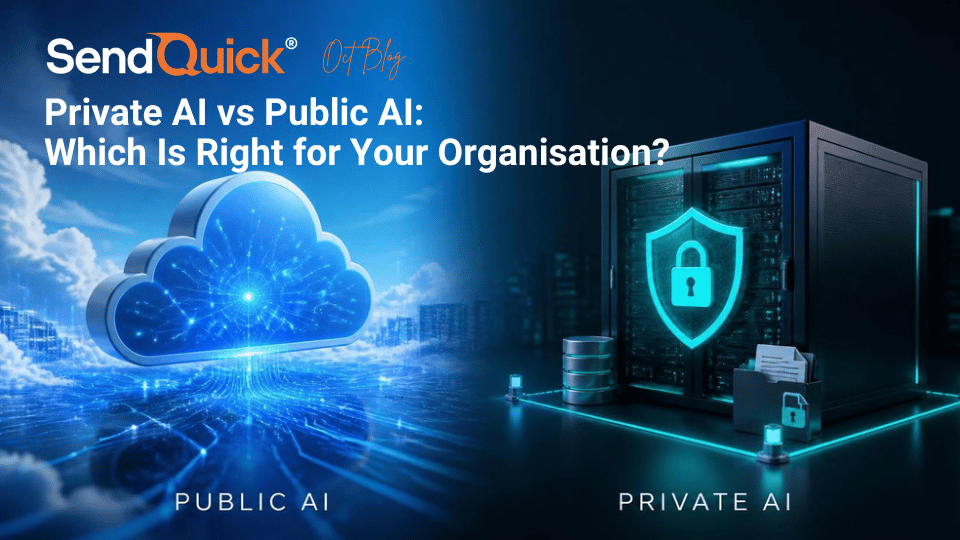
Private AI vs Public AI: Which Is Right for Your Organisation?
Artificial intelligence (AI) is transforming how organisations operate, helping businesses automate tasks, improve productivity and make better use of information. From customer service and internal knowledge management to business process automation, AI is becoming an increasingly valuable tool across industries.
However, as more organisations adopt AI, an important question arises: Should businesses rely on public AI platforms or deploy private AI within their own infrastructure?
While public AI services offer convenience and accessibility, organisations handling sensitive business information may have concerns about data privacy, security, regulatory compliance and control over their information.
Understanding the differences between private AI and public AI can help organisations choose an approach that meets their operational requirements, security policies and long-term business objectives.
What Is Public AI?
Public AI refers to AI services typically accessed through cloud-based platforms operated by third-party providers. These services allow users to interact with AI models through web applications, APIs or integrated business tools without managing the underlying infrastructure.
Popular examples include ChatGPT, Google Gemini and Microsoft Copilot.
Public AI platforms offer businesses a convenient way to introduce AI into daily operations. Employees can use these tools to generate content, summarise documents, analyse information and automate routine activities.
One of the main advantages of public AI is its accessibility. Organisations can begin using AI without investing in dedicated hardware or maintaining their own AI infrastructure.
However, depending on the service, subscription and configuration, information submitted to public AI platforms may be processed or stored within the provider’s cloud environment.
For organisations managing confidential customer records, proprietary business information or regulated data, this may introduce additional considerations around data governance, residency and compliance.
What Is Private AI?
Private AI refers to AI systems deployed within an organisation’s controlled infrastructure, such as on-premises servers or a dedicated private cloud environment.
Unlike public AI services, private AI enables organisations to manage their AI models, data processing and access controls according to their own security and operational requirements.
Private AI solutions can use locally deployed large language models (LLMs) to process information without relying on external AI services.
This allows organisations to retain greater control over how sensitive information is accessed, processed and stored.
For example, an organisation can deploy a private AI assistant that retrieves information from internal documents, knowledge bases, standard operating procedures (SOPs) and enterprise databases.
Employees can then ask questions and retrieve relevant information without needing to manually search through multiple systems.
For businesses operating in regulated industries or environments with strict data governance requirements, private AI provides an alternative approach to adopting AI while maintaining control over sensitive information.
Private AI vs Public AI: What Are the Key Differences?
Although both private AI and public AI can support business productivity and automation, they differ in deployment, infrastructure management, data governance and cost structure.
| Features | Public AI | Private AI |
|---|---|---|
| Deployment | Third-party cloud platforms | On-premises or private cloud |
| Data control | Governed by provider terms and configurations | Managed within the organisation’s environment |
| Data privacy | Depends on provider policies and service tier | Greater control over data processing and storage |
| Internet connectivity | Generally requires connectivity | Can support offline or air-gapped environments |
| Customisation | Depends on available provider features | Can be tailored to internal knowledge and workflows |
| Infrastructure | Managed by service provider | Managed internally or by a designated service partner |
| Cost structure | Typically subscription or usage-based | Infrastructure, licensing and maintenance costs |
| Compliance | Depends on provider controls and contractual arrangements | Supports organisation-defined data governance requirements |
The right choice depends on the organisation’s security policies, available resources and intended AI applications.
Why Are Organisations Considering Private AI?
1. Greater Control Over Sensitive Business Data
Data privacy is one of the most important considerations when adopting AI.
Organisations frequently handle confidential documents, customer information, financial records, intellectual property and operational data.
When employees use external AI services, businesses need to understand how submitted information is processed, retained and protected.
Private AI allows organisations to process information within their chosen infrastructure, reducing the need to transmit sensitive data to external AI providers.
This is particularly relevant for organisations that must maintain strict control over confidential business information.
2. Supporting Data Sovereignty and Regulatory Requirements
Different industries and countries have specific requirements governing how information should be handled and protected.
For organisations operating in Singapore and Malaysia, data governance considerations may include Singapore’s Personal Data Protection Act (PDPA), Malaysia’s Personal Data Protection Act and applicable sector-specific regulations.
Private AI can help organisations establish greater control over where information is stored and processed.
By deploying AI within approved infrastructure, businesses can align AI operations with their internal security policies and applicable data residency requirements.
However, private deployment does not automatically guarantee regulatory compliance. Organisations must still implement appropriate access controls, governance policies and security measures.
3. Reducing Dependence on External AI Services
Many public AI platforms depend on internet connectivity and third-party service availability.
For organisations operating in restricted environments, critical infrastructure or locations with limited connectivity, this dependence may present operational challenges.
Private AI can be deployed in offline or air-gapped environments, provided the required models and supporting components are hosted locally.
This enables organisations to maintain access to AI capabilities without requiring continuous connectivity to external AI platforms.
4. Customising AI with Internal Business Knowledge
General-purpose AI models are trained on broad datasets but may not have access to an organisation’s internal procedures, product documentation or business knowledge.
Private AI can be connected to approved enterprise information sources to deliver responses that are more relevant to specific business requirements.
Using Retrieval-Augmented Generation (RAG), organisations can allow AI applications to retrieve information from internal documents and knowledge bases before generating responses.
For example, employees can ask an internal AI assistant about company policies, technical troubleshooting procedures or product specifications.
This helps reduce the time spent searching for information and supports more consistent knowledge sharing across departments.
5. Greater Predictability in AI Operating Costs
Public AI services commonly use subscription-based or usage-based pricing models.
As AI adoption expands across departments, organisations may face increasing costs associated with user licences, API requests or model consumption.
Private AI typically involves infrastructure, deployment, licensing and maintenance costs.
Although the initial investment may be higher, organisations with consistent or substantial AI workloads may benefit from a more predictable cost structure.
The overall cost-effectiveness depends on hardware requirements, model performance, usage volume, maintenance and operational resources.
When Is Public AI the Better Choice?
Public AI remains a practical option for many businesses, particularly those looking to adopt AI quickly without managing dedicated infrastructure.
For general tasks such as drafting marketing content, brainstorming ideas, summarising non-sensitive information or conducting research, public AI services can provide convenient access to advanced AI capabilities.
Public AI may also be suitable for organisations that require access to frequently updated models, specialised AI services or scalable cloud infrastructure.
However, businesses should evaluate the provider’s data handling policies, contractual protections and enterprise security features before submitting sensitive information.
When Should Organisations Consider Private AI?
Private AI may be particularly suitable when an organisation needs to maintain greater control over its information, operate within restricted environments or customise AI applications using proprietary business knowledge.
Banking and Financial Services
Financial institutions manage confidential customer information, transaction records and internal financial documents.
Private AI can support internal knowledge retrieval, compliance documentation searches and employee assistance while keeping data processing within approved environments.
Government and Public Sector
Government agencies often operate under strict information security and data governance requirements.
Private AI can support internal document searches, administrative workflows and knowledge management within controlled infrastructure.
Healthcare
Healthcare organisations manage sensitive patient information, clinical procedures and operational documentation.
Private AI can assist authorised personnel with internal knowledge retrieval and administrative processes while supporting established data access policies.
Manufacturing and Semiconductor
Manufacturing organisations rely on technical manuals, maintenance procedures, equipment documentation and operational knowledge.
Private AI can help engineers retrieve troubleshooting information, access SOPs and support equipment maintenance activities more efficiently.
Energy, Utilities and Critical Infrastructure
Organisations managing essential services may operate in highly restricted or isolated network environments.
Private AI can support internal technical knowledge management and operational documentation without requiring external AI connectivity.
How SendQuick AI-in-a-Box Helps Organisations Deploy Private AI
SendQuick AI-in-a-Box is a private AI solution designed for organisations seeking to adopt artificial intelligence while retaining control over their data and infrastructure.
Unlike public AI services that typically process information through external cloud platforms, SendQuick AI-in-a-Box enables organisations to deploy a private large language model environment within their chosen infrastructure.
The solution supports on-premises servers, virtual machines and private cloud deployments, including environments where external internet connectivity is restricted.
With an integrated AI environment, organisations can build internal knowledge assistants, automate information retrieval and develop AI-powered workflows using their own business information.
Enterprise Knowledge Base
SendQuick AI-in-a-Box allows organisations to connect approved internal knowledge sources, including documents and other supported data repositories.
Employees can ask questions and retrieve information based on relevant enterprise knowledge.
This helps organisations make better use of existing information while reducing time spent searching through documents and internal systems.
AI Chatbots and Virtual Assistants
Organisations can develop AI-powered chatbots and virtual assistants to support internal enquiries, employee onboarding, technical assistance and customer service workflows.
For example, an internal IT support assistant can help employees locate troubleshooting instructions or answer frequently asked questions using approved company documentation.
Flexible Deployment and Data Control
SendQuick AI-in-a-Box supports private deployment options, allowing organisations to choose infrastructure that aligns with their operational and security requirements.
For environments requiring greater isolation, locally hosted models can operate without sending prompts and enterprise documents to external public AI services.
This provides businesses with greater control over their AI environment, data processing and access policies.
Frequently Asked Questions About Private AI and Public AI
-
1. What is the main difference between private AI and public AI?
The main difference is how AI infrastructure and data processing are managed. Public AI typically operates through third-party cloud services, while private AI runs within infrastructure controlled by an organisation, providing greater control over data handling and deployment.
-
2. Is private AI more secure than public AI?
Private AI can offer greater control over data processing, access permissions and infrastructure. However, security depends on implementation, system configuration, ongoing maintenance and governance. Both private and public AI require appropriate security controls.
-
3. Can private AI operate without internet access?
Yes. Private AI can operate offline or in air-gapped environments when the AI models, knowledge sources and supporting components are hosted locally.
-
4. Is private AI suitable for small and medium-sized businesses?
Yes. Private AI can be suitable for businesses of different sizes, depending on their data privacy requirements, infrastructure resources, budget and intended use cases.
-
5. Can private AI use an organisation's internal documents?
Yes. Private AI solutions can use techniques such as Retrieval-Augmented Generation to retrieve relevant information from authorised internal documents and knowledge bases, helping employees access business-specific information.
Choosing the Right AI Strategy for Your Organisation
Both private AI and public AI offer valuable capabilities, but the right approach depends on business priorities.
Public AI provides convenience, accessibility and access to advanced cloud-based AI services. Private AI offers greater control over data processing, deployment environments and integration with internal business knowledge.
For organisations handling sensitive information, operating in regulated industries or requiring AI within controlled infrastructure, private AI may provide a more suitable foundation for long-term adoption.
Businesses may also consider a hybrid AI strategy, using public AI for approved general-purpose tasks while reserving private AI for sensitive information and internal business applications.
Take Control of Your AI with SendQuick AI-in-a-Box
Adopting AI should not mean giving up control over your organisation’s information.
SendQuick AI-in-a-Box enables businesses to deploy private AI within their own infrastructure, helping them benefit from enterprise AI capabilities while maintaining greater control over data privacy, security and operational requirements.
Whether your organisation is exploring internal knowledge assistants, AI-powered customer support or business process automation, SendQuick AI-in-a-Box provides a flexible foundation for private AI adoption.
Discover how SendQuick AI-in-a-Box can support your organisation’s AI journey.
Visit www.sendquick.com or contact info@sendquick.com to learn more.